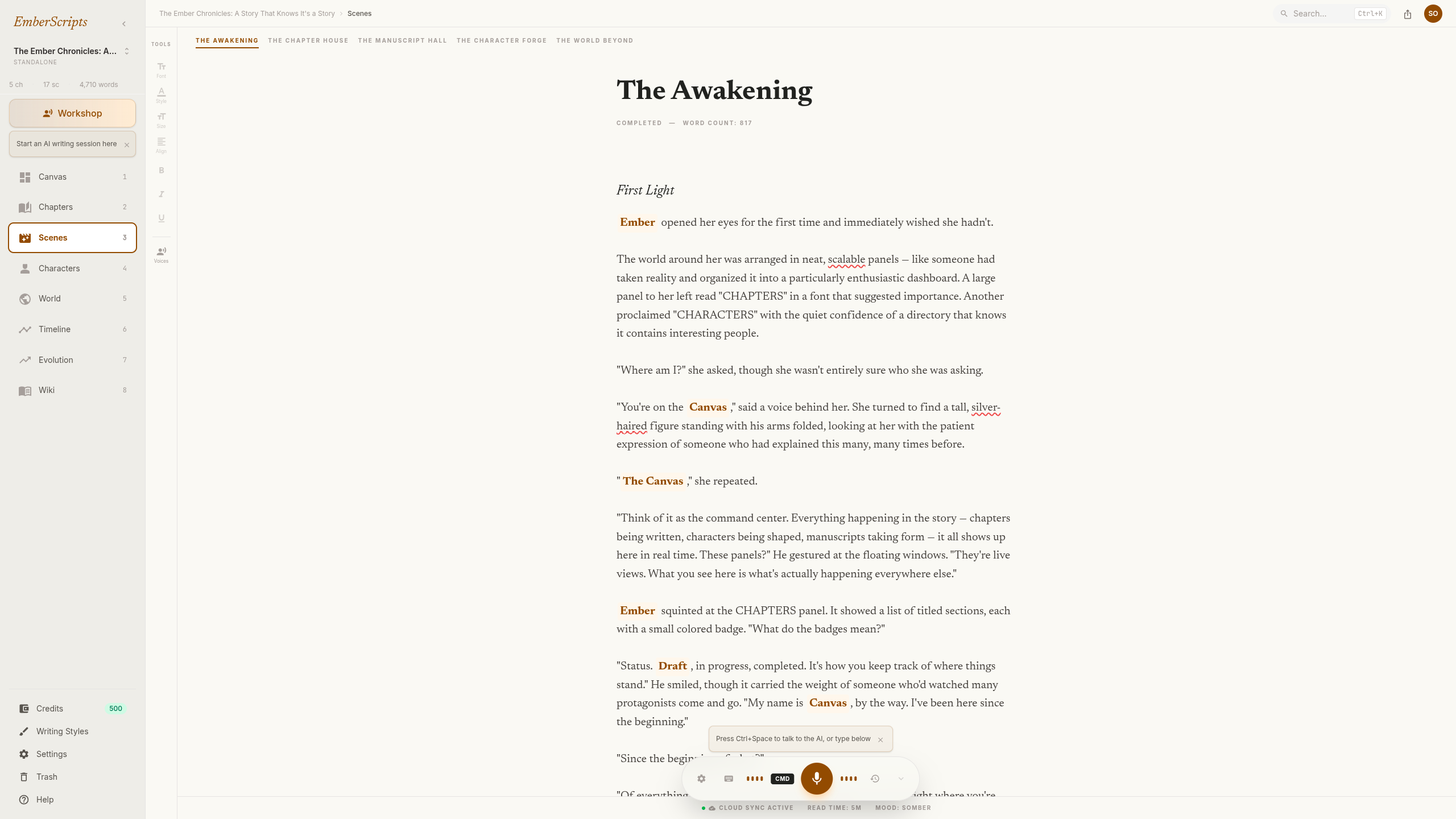
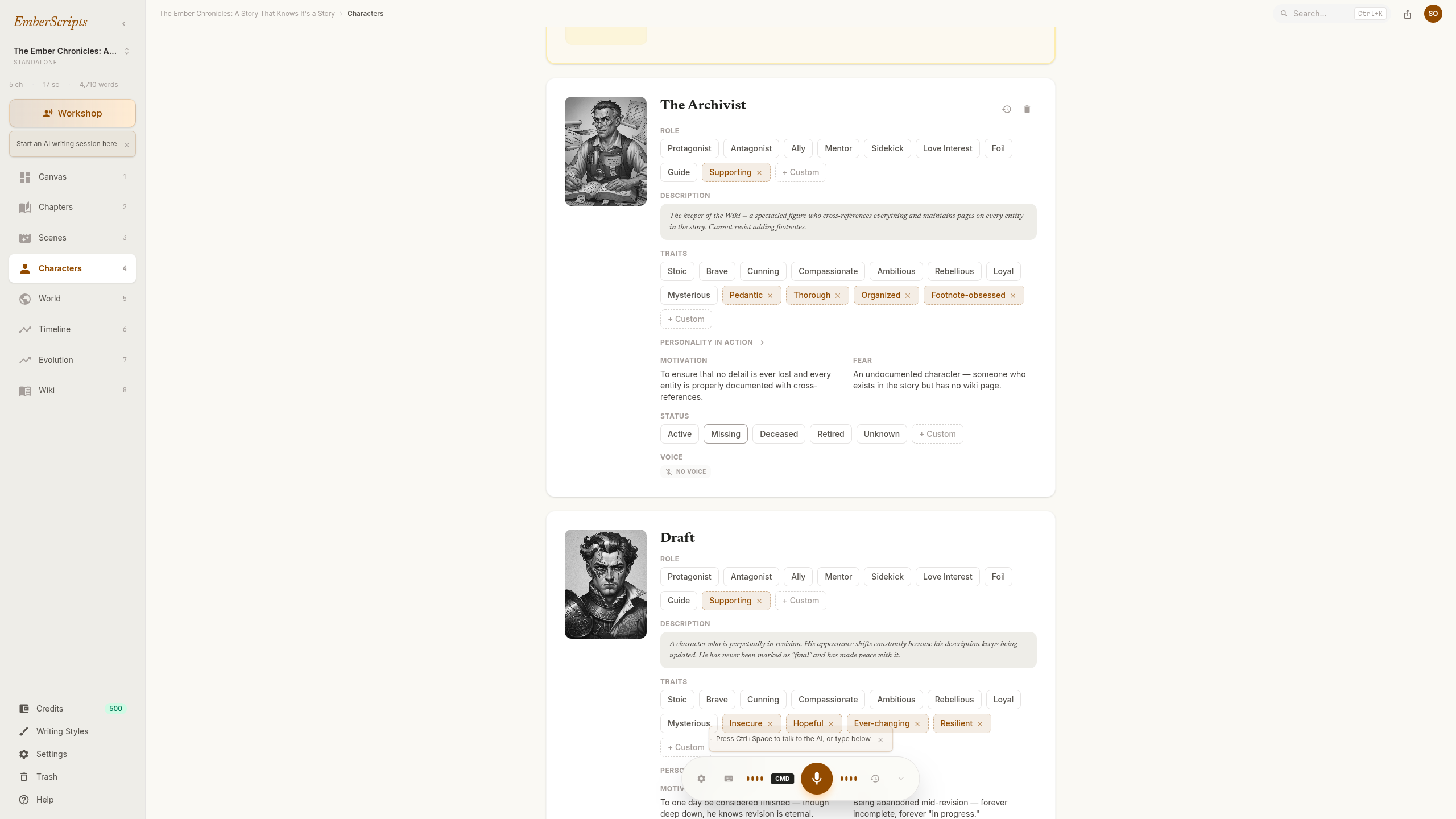
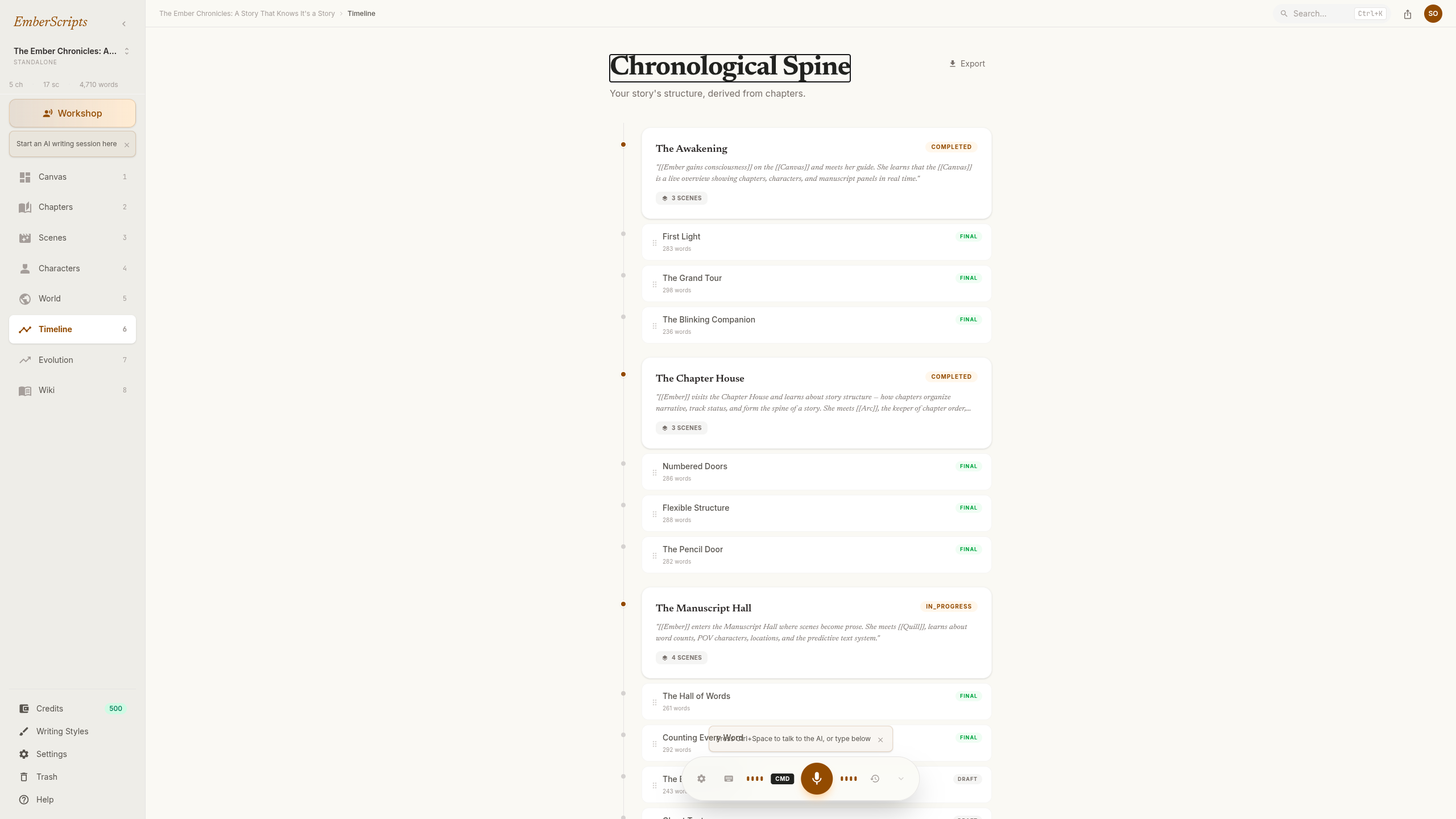
Characters, world, and timeline live as real data the AI reads on every turn — so it remembers Maren is missing her left hand in chapter twelve. Speak or type, your choice.
By continuing, you agree to our Terms and Privacy Policy.
Built by one person, in the open. No VC, no growth team — just a writing tool that does the thing it says it does.
Continuity, by default
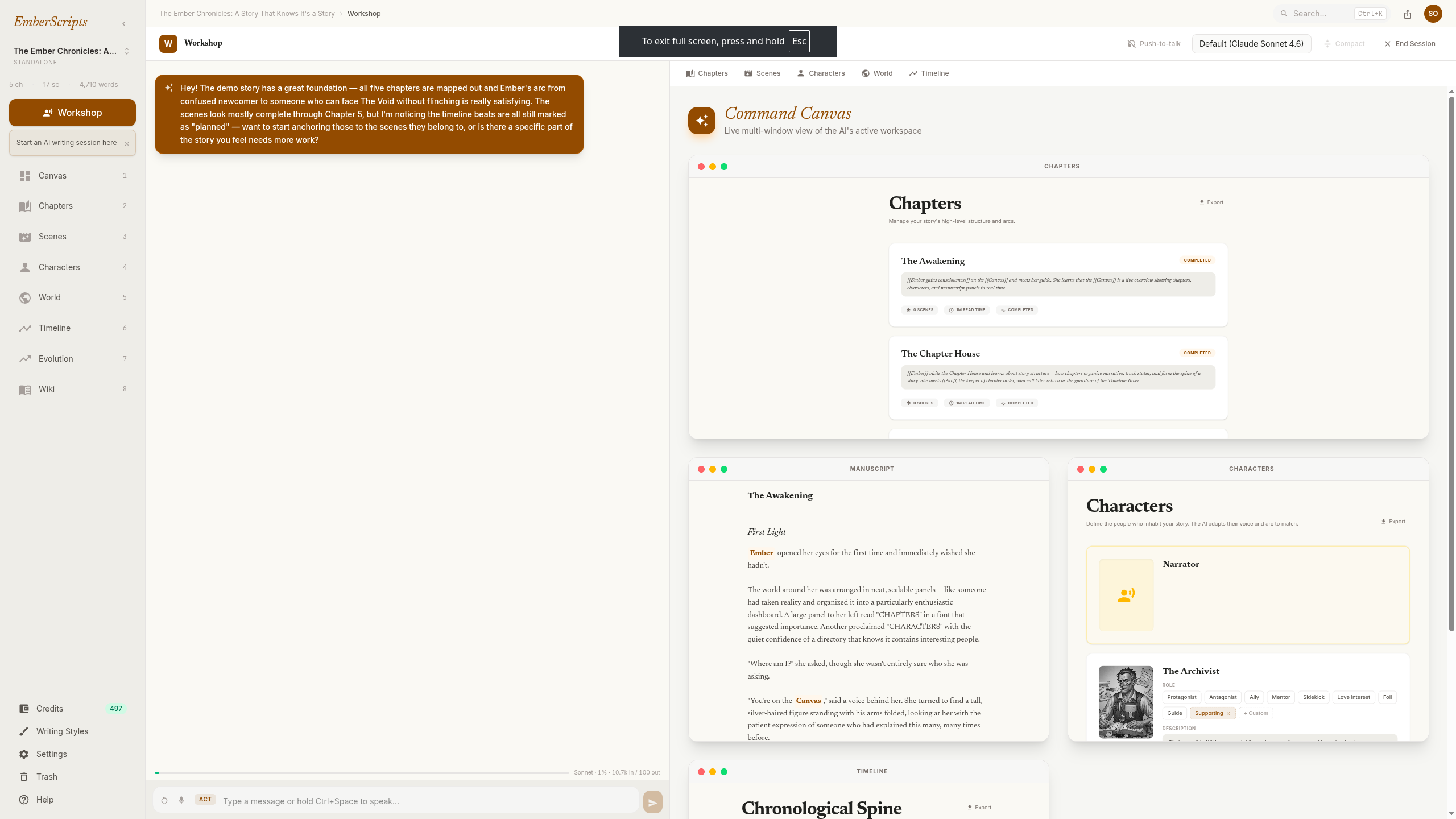
Every character, location, faction, and timeline beat you mention becomes a row in your private database — not a note in a hidden chat history. The agent reads it before every reply. Open the canvas and you can see what it sees.
Write [[Maren]] mid-sentence. Hover it: portrait, traits, last appearance. Click it: jump to her full page. Like Obsidian, but the AI keeps it current.
Tradeoff worth naming: we're slower than Sudowrite on raw word generation because the agent reads your canon every turn. That's the trade we made on purpose.
Capture however you think
Push-to-talk in command mode and the AI drafts what you described. Push-to-talk in dictate mode and your words land at the cursor. Or never touch the mic — every voice feature is optional, and the keyboard path is first-class.
Open Workshop and you're in a conversation. You talk. It asks the clarifying question. It drafts in your voice. The canvas next to the chat updates live as new characters and timeline beats land — no refresh, no copy-paste.
What's running underneath
Most of what makes EmberScripts feel different is invisible — running underneath while you write. The pieces worth knowing about.
OpenRouter
Bring your OpenRouter key and route every workload separately. Sonnet for the agent, Haiku for fast ghost-text, Opus for deep workshops — or swap in Gemini, GPT, or an uncensored fiction model. Your keys, your call.
ElevenLabs
Bring an ElevenLabs key, clone voices from a sample, assign per character. Workshop reads dialogue back to you in the right voice. No key? Gemini TTS is the built-in fallback.
Don't have a key? Sign up at ElevenLabs ↗Vault import
Drag in an Obsidian folder or a stack of .docx chapters. The AI extracts characters, locations, scenes, and timeline beats. Preview every extraction before it commits. Wikilinks survive the round trip.
Sync
Write a paragraph on your phone on a walk; it's on your desktop the moment you sit down. Realtime, debounced, scoped to the story you're in. No conflicts.
Privacy posture
Row-level security in Postgres enforces account isolation at the storage layer. Claude only sees what you ask it to. Deepgram only sees what you speak. No harvested-data training pipeline, ever.
No lock-in
Chapters, scenes, characters, world entities — wikilinks intact. Drop the export straight into an Obsidian vault. Your story leaves the way it came in.
500 free credits on signup. No card. About fifteen seconds to your first draft.
Start writing — freeNo interview, no setup wizard. Three steps from cold visitor to drafting.
Google or email. 500 credits land in your account.
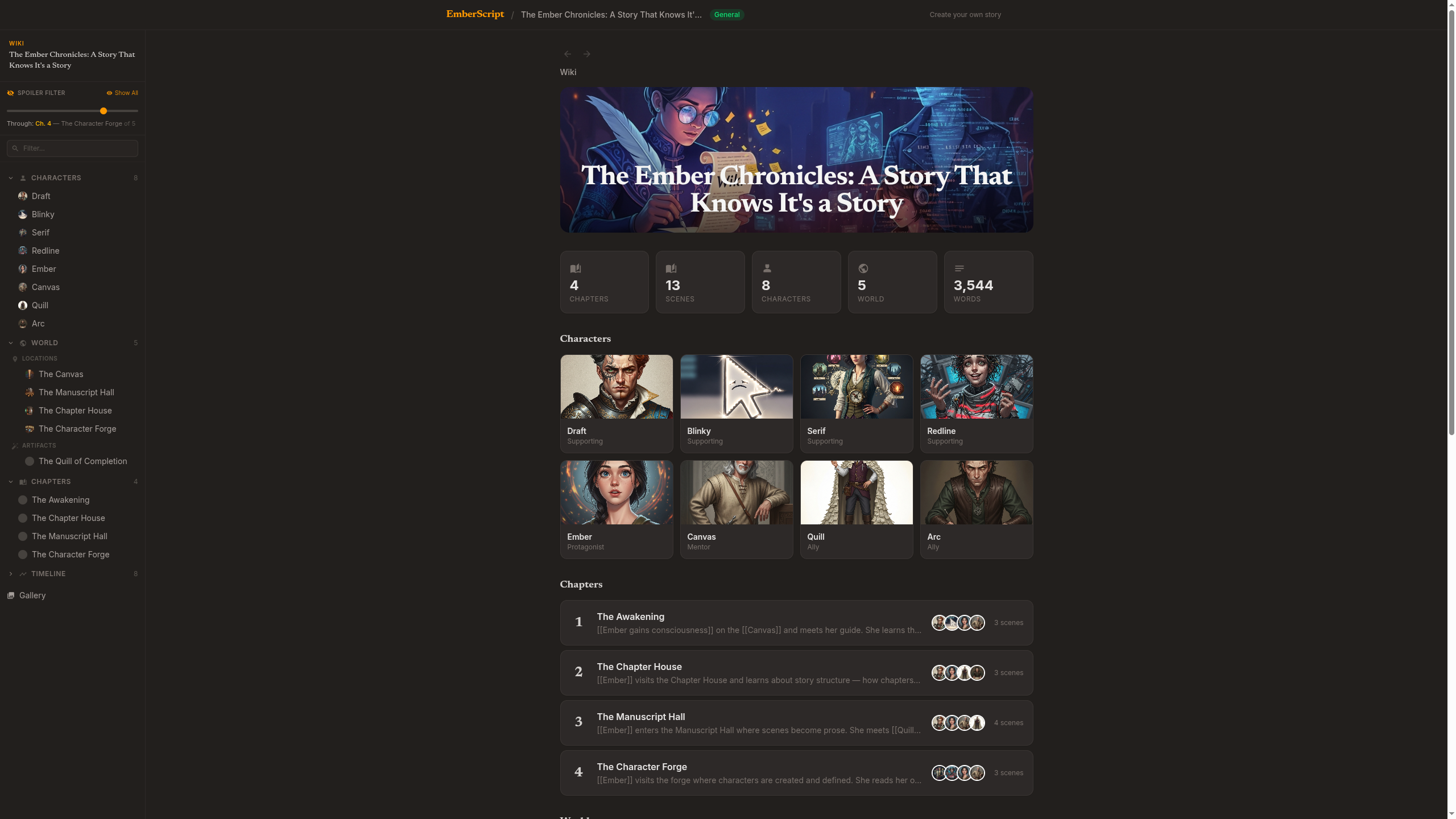
Every new account starts inside *The Ember Chronicles* — a self-referential novella where the protagonist learns the app by navigating it. Click into characters. Hover wikilinks. Make a change.
Name it. Speak the opening, type the opening, or ask Workshop to draft a scene. Hand off in either direction whenever.
The same wiki view your readers would see if you published your own story. Open the demo in a new tab ↗
Built for long-form
Novels, novellas, serials, screenplays. Worldbuilding-heavy fiction is where this earns its keep — not marketing copy, not academic writing.
She drags the vault in. Characters and locations import with wikilinks intact. Workshop drafts scene 47 in chapter 8 while the timeline updates beside her. The agent already knows who's left-handed and who isn't.
He drafts on a walk in dictate mode, narrates the scene back to test the rhythm, then publishes a public wiki view alongside the chapter so readers can browse canon between releases.
She speaks the cold open. Asks the agent to keep the protagonist's voice consistent across the act break. Exports to Markdown to paste into Final Draft — we're a layer in her stack, not the whole stack.
Every feature works for every user. Hosted inference is metered per token by model tier — fast, flagship, opus. Bring your own OpenRouter key and you pay $0 to us; the provider bills you directly.
New accounts start with 500 free credits
Sign up and use the whole app. Credits only enter the picture when you use our hosted AI inference — and even that's bypassable with your own key.
One-time purchases in USD, tax added at checkout. Credits stay on your account as long as you do — sign in or use the app and they don't go anywhere. Skip entirely if you're bringing your own keys. Full terms.
A taste, if you want one
The common top-up
Best value per credit
Or pay $0
BYOK skips our credit gate entirely — you pay your provider directly, we pass the call through. We'd rather you stay free than churn off a surprise bill.
Only when you use our hosted AI. Plug in an OpenRouter key and these drop to $0 — you pay the provider directly.
Built in the open
EmberScripts is built and maintained by one person. The roadmap and pricing reflect that scope — no growth team to satisfy, no investor deck to optimize for. The tradeoff: you won't get an enterprise SLA, but every feature ships because a writer asked for it. If something is broken, the person who broke it is the same person who'll fix it.
EmberScripts remembers Maren is missing her left hand in chapter twelve. Free to start. About fifteen seconds to your first draft.
Sign up with Google No card · 500 free creditsBy continuing, you agree to our Terms, Privacy Policy, and Credits & Payments terms.